
Meet Giuseppe Colucci. As Chief Growth Officer at Textbroker and co-founder of the Berlin SEO & Content Club, Giuseppe has spent over 12 years at the intersection of SEO, content strategy, and business growth.
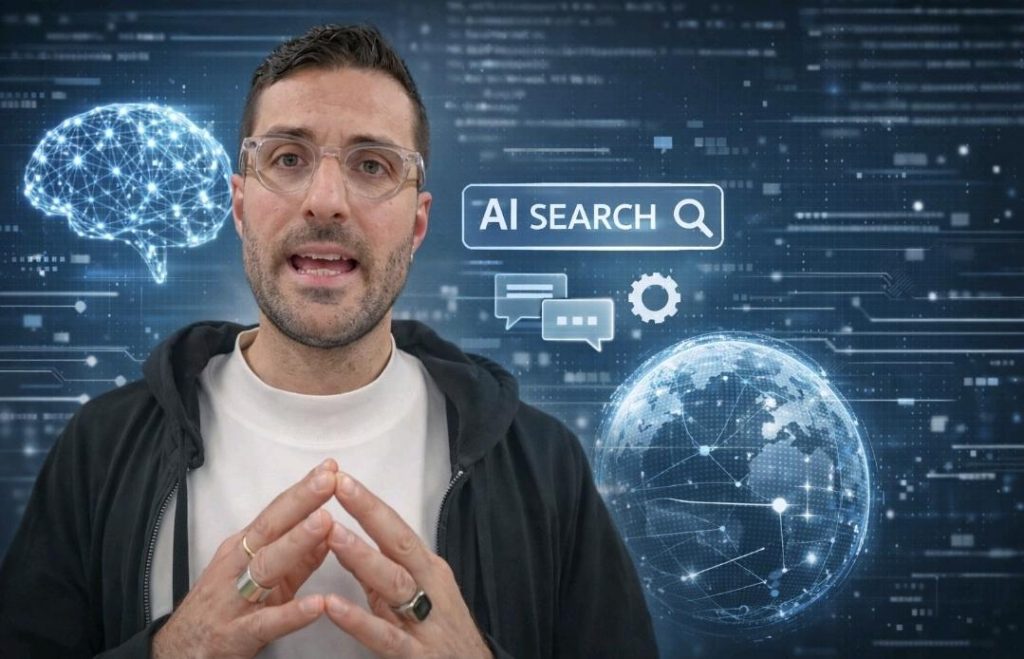
As we’re living through a fundamental shift, one where traditional search is giving way to AI synthesis, and where the rules of brand visibility are being rewritten in real time, Giuseppe’s perspective is grounded in something many overlook: While GEO provides the framework, it’s brand sentiment—the stories people tell about you across the open web—that determines a significant portion of how an AI actually surfaces you. In this conversation, we get into why that “invisible” layer of trust is becoming the most critical signal for AI visibility in 2026.
The New Landscape
Giuseppe, how has the definition of “brand authority” changed for you?
Brand authority used to be mostly a link equity game: who’s citing you, and how often. Today it’s much broader: LLMs build their understanding of a brand from the entire web ecosystem, not just backlinks. If people aren’t talking about you in forums, reviews, niche publications, and social spaces, you simply don’t exist in the AI’s mental model of your industry.
If it all depends on people talking about your brand, how does a brand’s online “vibe” act as the ultimate filter for whether an LLM decides to cite it?
LLMs don’t just index facts; they absorb patterns of perception. If the dominant narrative around a brand across Reddit threads, review platforms, and editorial mentions is consistent and credible, that brand becomes a “safe cite.” Sentiment is essentially the new domain authority, in a way, and it’s harder to fake.
So what happens to a high-quality brand that stays “silent” or fragmented across the web?
It gets ignored, regardless of how good the product is. AI systems need narrative coherence to build confidence in a brand, and consistent terminology to describe the products, services, etc. Fragmented or sparse signals mean the model has nothing solid to anchor a recommendation on. Silence in 2026 isn’t neutral; it’s a competitive disadvantage. At Textbroker, we call it the “Cost of Silence.”
Community & Data Fuel
Getting people to talk about you sounds easier than it is, right? How should brands build sentiment on Reddit, where traditional marketing is very much rejected?
Stop trying to market and start trying to contribute. Reddit communities reward genuine expertise and punish promotional tone almost instantly. That’s the only way in: being useful. Brands that do this well usually start by identifying where their subject-matter experts can answer real questions, not where their messaging fits. My colleague Cody, CEO of our US entity, explained that very well in the webinar we hosted a couple of weeks ago.
You mentioned the “Cost of Silence,” as you put it. When AI lacks “experience-based” data about a brand, how does that create a growth ceiling—and how do you break it?
Without experiential data (reviews, community mentions, first-person accounts, you name it), an LLM has no basis to recommend a brand for anything beyond superficial queries. The ceiling breaks when brands start systematically generating that layer: customer stories, expert commentary, community presence. It’s less about volume and more about depth and authenticity.
But how do you ensure a user trusts a brand even if they never click through to the website?
The website is increasingly just one touchpoint. Trust is built in the places where people talk to each other, not where brands talk at people. If your brand is consistently mentioned in the right contexts, with the right associations, the click becomes almost secondary. The goal is to be part of the conversation before the purchase decision even forms.
The Human-Led Solution
But it’s not just done with getting the name of your brand out there, right? How is Textbroker solving the “AI sameness” problem?
What LLMs actually prioritize for high-value queries is specificity, experience, and credibility signals that only real subject-matter experts can provide. Textbroker’s network of vetted specialists and experts produces content that carries that weight, which is fundamentally different from prompt-and-publish. And it does connect to EEAT signals.
Last but not least: Tell us why “human-in-the-loop” content creation is becoming the most critical competitive advantage in GEO.
Because AI can scale production, but it can’t manufacture credibility. As models get better at detecting nuance, the gap between content that was written by someone who actually knows something and content that was generated from existing patterns will become more visible, not less. Human expertise in the loop isn’t a nice-to-have: it’s what separates citable content from noise.
Quick Takes:
Most valuable currency for a brand in the age of AI?
Trust. Specifically, the kind you can’t manufacture overnight.
North Star of GEO in one word?
Relevance.
AI or Human: who wins the next decade of content?
The hybrid. The brands that figure out how to combine AI scale with genuine human expertise will outrun both the pure-AI and the fully manual players.
Most expensive mistake a brand can make in 2026?
Being invisible in the places where your audience actually talks. Is it Reddit? Then be on Reddit!