
By Nitin Manchanda, Founder & Chief SEO Consultant at Botpresso
Marketing is in the middle of a full-blown identity crisis. The SEO playbook that worked for the last fifteen years is being quietly rewritten by ChatGPT, Gemini, Perplexity, Claude, and Google’s AI Overviews. From founders at startups to CMOs at enterprises, the question on everyone’s mind is the same: “Why aren’t we showing up in AI answers?”
And it’s not just a vanity concern. AI search is changing how buyers discover, evaluate, and choose brands, often before a single click ever reaches your website.
In this article, I’ll walk through how AI search has evolved, how it actually works under the hood, why it matters for SEOs, and what a modern visibility strategy looks like.

1. The Impact of AI Search on Traditional Search
Let’s start with the uncomfortable part: traditional SEO traffic is shrinking, and the data is now hard to ignore.
A GrowthSRC Media study of 200,000+ keywords found that the click-through rate for Google’s #1 organic result dropped from 28% to 19%, a 32% relative decline, after the rollout of AI Overviews. Position #2 fell even more sharply, by 39%. Search Engine Journal reported the same finding, noting that AI Overviews now appear across a far wider share of queries than they did a year ago.
It gets worse in some markets. A SISTRIX analysis of 100 million German keywords found that when an AI Overview is present, the position-one CTR collapses from 27% to 11%, a 59% drop. And a Pew Research Center study of US searches found a 47% relative reduction in user click behavior when an AIO appeared.
Top-of-funnel content is taking the hardest hit. ZipTie.dev’s analysis noted that B2B tech queries now trigger AI Overviews around 70% of the time, with some sectors seeing 70 to 80% organic traffic drops. Glossary pages, definitions, “what is” explainers, and other informational assets, exactly the content SEO teams have spent years building, are the most vulnerable. HubSpot, one of the most widely cited examples, reportedly lost 70 to 80% of its organic traffic in this transition.
The world is inching closer to a zero-click SERP, and traffic is no longer the only outcome SEOs should be optimizing for. Brand perception is now being formed inside the AI answer itself, often without the user ever visiting your domain.
2. How Is AI Search Different from Traditional Search?
The mechanics of AI search are fundamentally different from a traditional Google query. Three differences matter most.
a) AI thinks more like a brain than a ranking algorithm
Traditional search works on signals: keywords, backlinks, freshness, and page experience. You could often “manipulate” rankings by reverse-engineering those signals.
AI engines work more like a human brain. They learn by reading vast amounts of content, building connections between concepts, and forming a parametric memory of how entities relate to each other. That’s why a brand that has never optimized for “best CRM for startups” can still get recommended if the wider web consistently describes it that way.
b) Query fan-outs
When a user enters a complex prompt, AI engines don’t just run that one query. They decompose it into many sub-queries that explore different angles. Google calls this “query fan-out.” As Google officially explains, “AI Mode uses our query fan-out technique, breaking down your question into sub-topics and issuing a multitude of queries simultaneously on your behalf.”
This is also described in Google patent US20240289407A1, “Search With Stateful Chat”, and the related “Thematic Search” patent (US12158907B1). The implication: your content might get cited not because it ranks #1 for the main keyword, but because it answers one of the hidden sub-queries best. As Search Engine Journal reported, Google’s VP of Product for Search, Robby Stein, confirmed this is active across AI Mode, Deep Search, and some AI Overview results.
c) Chunking and passage-level retrieval
AI engines don’t read full pages. They read passages. To stay within context windows and conserve compute, they break content into chunks and pull the most relevant ones into the answer. This is where Retrieval-Augmented Generation (RAG) comes in, the architecture that lets the model ground a generated answer in real, retrieved content from the web.
The practical takeaway: a page that’s structurally chunkable, with clean headers, self-contained sections, and unambiguous statements, has a far better shot at being cited than a long, meandering essay.
3. How Does AI Search Actually Work?
Simplifying the pipeline, an answer engine typically does four things:
- Intent extraction and personal context. It interprets what the user actually wants, often using past conversation history, location, or account preferences.
- Complexity assessment. It evaluates whether the answer can be served from its parametric (training) memory or whether it needs to ground in real-time web data.
- Query fan-out. Depending on complexity, it generates dozens, sometimes hundreds, of related sub-queries that cover the full intent space.
- Synthesis. It predicts the most probable answer by combining its training data with retrieved third-party sources, matching it against an internal prompt it builds for itself.
What’s important to understand is that the prompt the user types is not the prompt the model answers. The model expands, rewrites, and elongates that prompt internally, and then synthesizes a response from whatever sources best satisfy each sub-query.
That’s why ranking #1 on Google isn’t enough anymore. You also need to be discoverable across the full spectrum of sub-queries an AI is likely to generate around your category.
4. Should SEOs Even Think About AI Search?
Yes. And the data is moving fast in one direction.
- The AI chatbot market grew 152% YoY between January 2025 and January 2026, according to Apptopia data reported by Fortune and Apptopia directly.
- ChatGPT has 800+ million weekly active users, as announced by OpenAI’s Sam Altman at Dev Day in October 2025, with over 2.5 billion prompts per day according to Semrush.
- Position #1 CTR has dropped 32% post AI Overviews rollout, per the GrowthSRC study cited earlier.
But the more interesting number for SEOs is this one:
Users who search via LLMs are 4.4x more likely to convert than those using traditional search engines.
That stat comes from Semrush research, and Semrush expects AI search channels to drive comparable economic value to traditional search by 2027, and to surpass it shortly after.
Why such a dramatic conversion lift? Three reasons:
- AI barely sends traffic for informational intent. Most of the volume that flows through to a website is mid- or bottom-funnel.
- AI is built for fulfilling specific intent. When a buyer is in solution-narrowing mode, ChatGPT aligns its recommendations with commercial pages and shortlists, not with definitional content.
- Visitors are better informed. They arrive having already done a hyper-personalized, conversational research journey with the LLM. They’re not browsing, they’re deciding.
Lower volume, higher intent, better conversions. That’s the new shape of the funnel.
5. How to Master AI Search Visibility for Your Brand
Before getting into the “how,” it’s worth understanding the two ways your brand can “show up” inside an AI answer:
| URL Citation | Brand Recommendation | |
|---|---|---|
| What happens | LLM links your URL as a source | LLM mentions your brand in the answer text |
| Driven by | Grounding (real-time search/RAG) | Parametric memory (training data) |
| Influenced by | Crawlability, information density, content freshness, recency, niche expertise | Brand reputation, historical presence, entity co-occurrence, sentiment |
A URL citation means your content was used as a source. A brand recommendation means your brand was suggested. These are very different outcomes, and they’re influenced by very different signals. Most strategies focus only on citations, but recommendations are usually what move pipeline.
It’s also worth noting how lazy AI engines can be when assembling shortlists. Profound research presented at brightonSEO in September 2025, and confirmed in a Wix Studio AI Search Lab analysis of 75,000 AI answers, found that listicles and comparative content account for around 21 to 25% of all AI citations. For commercial-intent queries, listicles capture roughly 40% of citations. Translation: if you’re not featured in third-party listicles or publishing credible comparative content yourself, you’re invisible in a huge chunk of buying queries.
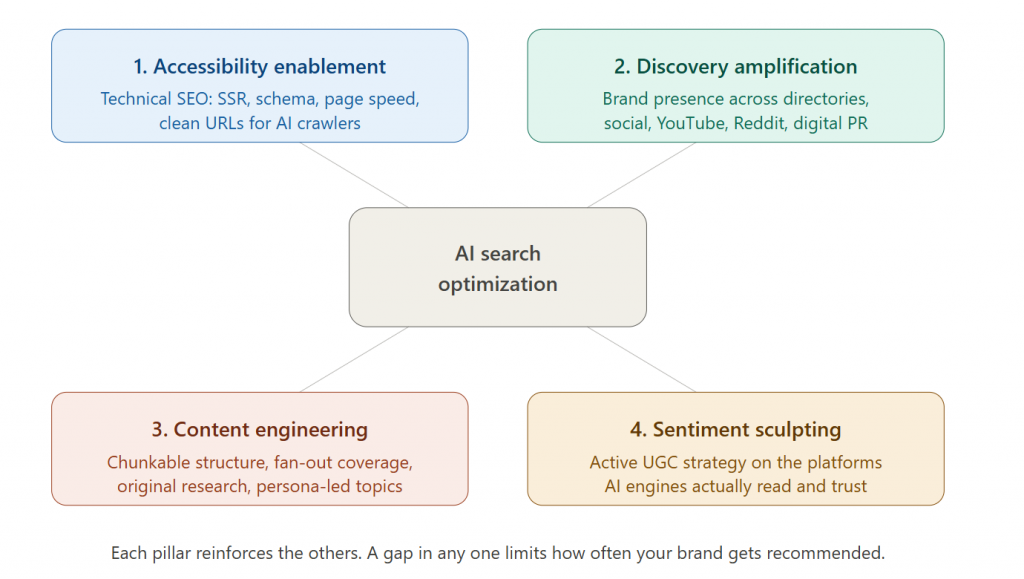
So how do you actually win? At Botpresso, we approach AI search optimization as a category-contextualized exercise, what’s “important to AI engines” varies a lot by industry. But the framework breaks down into four pillars.
Pillar 1: Accessibility Enablement (Technical SEO)
If AI crawlers can’t access, parse, or chunk your site, nothing else matters. Botpresso conducted a study with Semrush analyzing 5 million URLs cited by ChatGPT Search and Google AI Mode to identify which technical SEO factors correlate with AI citations.
The patterns that emerged:
- Avoid heavy JavaScript rendering. Implement server-side rendering so content is visible without execution.
- Use structured data thoughtfully. Organization, Article, and BreadcrumbList schema appear most frequently on cited pages, with even higher rates on Google AI Mode citations.
- Optimize page speed. Cited URLs consistently show stronger user engagement signals, including longer visit duration and lower bounce rates.
- Use clean, descriptive URLs. URLs with slugs of 17 to 40 characters received the most citations in the study.
Pillar 2: Discovery Amplification
AI engines don’t just look at your domain. They look at what the collective internet says about you. If your brand isn’t being discussed elsewhere, if no one is quoting your point of view, if you have no presence in trusted third-party sources, you won’t get recommended.
This pillar covers two sides:
- On-site: Updated brand details, detailed offering descriptions, brand-industry relevance, and content that targets high-intent buyer personas.
- Off-site: Brand directory listings and reviews, social media equity (especially YouTube, since YouTube and Reddit combined account for 78.2% of AI social media citations), and digital PR aimed at building category association.
Pillar 3: Content Engineering
This is where most teams get it wrong. AI-optimized content isn’t just “good SEO content with FAQs bolted on.” It’s content engineered for retrieval. Four things matter:
- Hyper-focused buyer-persona-led topic research. Don’t write for traffic volume. Write for the specific high-intent questions your buyer asks.
- Query fan-out addressal. Map your content to the sub-queries an AI is likely to generate from your core topic, not just the head term.
- Chunkable content structure. Self-contained sections, clear sub-headers, atomic paragraphs, comparison tables, and direct answers up front. SE Ranking research cited in this Medium analysis found that pages structured into 120 to 180-word sections earned 70% more citations than pages with very short sections.
- Original, citable research and points of view. Ahrefs found that AI-cited content is 25.7% fresher than organic Google results (median age of 1,064 days vs 1,432 days). Originality and recency both compound.
Pillar 4: Sentiment Sculpting
Answer engines love user-generated content. Reviews, Reddit threads, Quora answers, YouTube videos, all of these shape how an LLM characterizes your brand. Semrush’s research found that Quora and Reddit are among the most commonly cited sources in Google AI Overviews. If the conversation about your brand on these platforms skews negative, no amount of on-site optimization will fix the recommendation gap.
Sentiment sculpting means actively building positive UGC presence in the right places for your industry: review aggregators, niche communities, subreddits, YouTube creators, and so on.
How Do You Know If Your AI Search Strategy Is Working?
This is where most teams are still measuring with the wrong yardstick. Here’s a quick view of what to retire and what to track:
| Metrics to Retire | Metrics to Track |
|---|---|
| Top-of-funnel traffic | AI Share of Voice: citation rate and brand mentions in AI answers |
| Vanity impressions | Multi-platform online brand sentiment |
| Keyword rankings (in isolation) | Conversion and pipeline impact from AI |
| CTR on informational queries | Direct traffic and brand search lift |
The shift in mental model is from “how much traffic did SEO send” to “how often did our brand get recommended, and what pipeline did that drive?”
Breaking the Silo: AI Search Is Bigger Than SEO
Here’s the hardest organizational truth in all of this: AI search optimization cannot live inside a siloed SEO team anymore. Winning in AI requires interdisciplinary support, from PR (for digital PR and brand mention building), partnerships, product (the offerings AI recommends have to actually exist and be clearly described), paid (for testing demand against AI-influenced segments), social and video (because YouTube and Reddit are massive citation sources), and brand marketing (because parametric memory is fundamentally a brand-equity asset).
The SEO teams that will win in 2026 and beyond are the ones that stop trying to do this alone and start orchestrating across functions.
Closing Thought
AI search isn’t replacing SEO. It’s re-scoping it.
The fundamentals of accessibility, authority, content quality, and brand presence still matter. They just matter in different proportions, are measured by different KPIs, and require coordination across functions that used to operate independently.
The brands that adapt early are already seeing the upside: lower-volume but dramatically higher-converting traffic, faster pipeline movement, and brand inclusion in shortlists that used to require expensive paid campaigns to land in.
If your AI search strategy still looks identical to your 2023 SEO strategy, you’re already behind.
Published by Botpresso. For category-contextualized AI search optimization strategies, visit botpresso.com.